Contextualise
No result should be interpreted outside the person's clinical, educational, occupational, emotional and functional history.
Neuropsychology
A project focused on how neuropsychological assessment results can be integrated with clinical history, context, everyday functioning and professional reasoning.
01
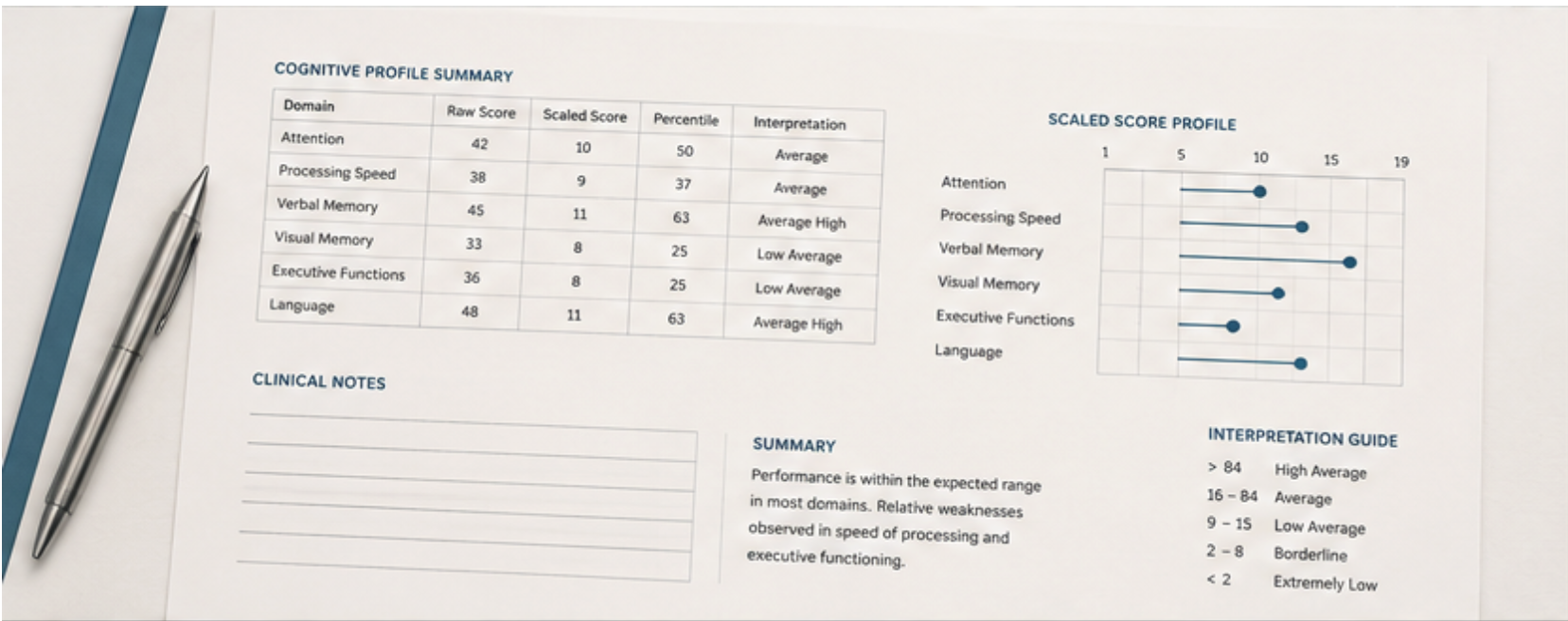
Neuropsychological assessment generates a large amount of information: scores, cognitive profiles, behavioural observations, clinical history and data about everyday functioning.
However, none of these elements has enough interpretative value when considered in isolation.
This project explores how different sources of information can be integrated to build a more rigorous, contextualised and clinically useful interpretation.
02
A neuropsychological score describes a person's performance on a specific task under particular conditions.
It does not automatically explain why that result was obtained, what it means for that individual or what impact it has on everyday life.
Age, education, emotional state, fatigue, pain, medication, premorbid functioning, sociocultural context and sensory impairments can all modify performance.
The clinical challenge is to distinguish between data, interpretation and inference.
03
No result should be interpreted outside the person's clinical, educational, occupational, emotional and functional history.
Interpretation requires combining tests, clinical observation, interview, functional information and other relevant sources.
Scores are data. Hypotheses about their meaning require clinical reasoning and should remain open to revision.
An apparently exact number can communicate more certainty than the assessment actually supports.
04
Cognitive assessment is not simply the administration of standardised tests.
It requires selecting appropriate instruments for the clinical question, checking the validity of the results and relating the profile obtained to the available information.
Vigilance, sustained attention, selective attention, divided attention and processing speed.
Encoding, learning, storage, retrieval and recognition of verbal and visual information.
Cognitive flexibility, inhibition, planning, monitoring and problem solving.
Naming, fluency, comprehension and other language functions relevant to the clinical profile.
Perception, construction, orientation and spatial processing.
05
Clinical reasoning transforms assessment results into hypotheses about cognitive functioning.
This process requires identifying patterns, inconsistencies, modifying factors and possible alternative explanations.
Use the available data to generate provisional explanations rather than closed conclusions.
Consider different clinical explanations before attributing a result to a specific neurological process.
Analyse whether results are consistent across tests, cognitive domains and everyday functioning.
Keep conclusions open when new clinical, functional or biomedical data become available.
06
One of the questions that interests me most is how to represent complex clinical information without reducing it to a single score.
Neuropsychological data may become more valuable when they are integrated with functional, longitudinal, behavioural and biological variables.
This approach opens relevant questions for data visualisation, cognitive monitoring and the development of digital tools that support clinical reasoning.
07
This project is conceptual and educational in nature.
No identifiable information from real patients is used or will be published.
Examples, diagrams and potential datasets used to develop concepts will be fictional, anonymised or obtained from appropriate public sources.
Protecting privacy and ensuring appropriate interpretation of clinical information are part of the design of the project itself.
08
This project will progressively evolve towards more structured representations of neuropsychological reasoning and data integration.
Future areas of work include longitudinal visualisation of cognitive performance, representation of multidimensional profiles and the study of explainable computational tools to support the clinical process.
The aim is not to automate interpretation, but to explore how technology can help organise complex information while keeping context and uncertainty visible.